No. 03
The Compiler Nobody Wanted
In 1952, Grace Hopper built a program that could write programs. Her colleagues said it was impossible. The code running in your bank today…
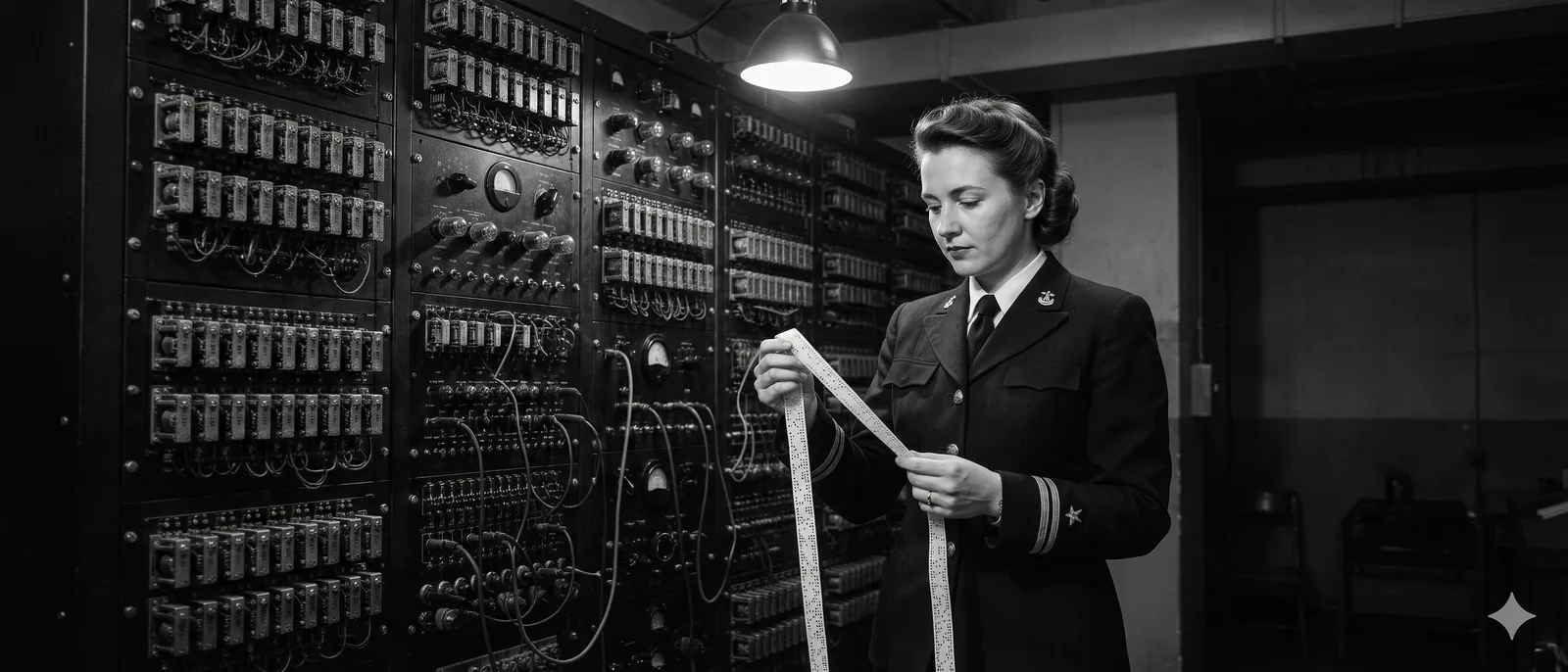
She had a working program that could write programs. It ran on the most advanced computer in the country. For two years, no one would touch it.
On the morning of July 2, 1944, Lieutenant Junior Grade Grace Brewster Murray Hopper arrived at Harvard University, stepped through the doors of a building called the Computation Laboratory, and met a machine for the first time.
It was fifty-one feet long and eight feet high. It weighed five tons. Its official name was the Automatic Sequence Controlled Calculator; everyone called it the Mark I. It was the most sophisticated computing device in the United States. Howard Aiken, who had built it, was standing beside it. He looked at the new arrival and said: “Where have you been?”
Hopper was thirty-seven years old. She had a PhD in mathematics from Yale. She had spent the previous decade teaching at Vassar College. She had just completed officer’s training with the U.S. Naval Reserve, ranking first in her class. She had no experience with the machine in front of her.
Aiken told her she had three days to learn to program it and produce output.
She worked without leaving for three days. By the fourth morning, she had produced results. Aiken, whose default mode was something between impatience and contempt, looked at what she had done and said nothing. That, she learned, was what approval sounded like from Howard Aiken.
Eight years later, in a different room, nobody would look at what she had built. That is the story. And why the software that now processes three trillion dollars of commerce every day exists despite that room, not because of it.
Act I: The Machine That Needed a Priest
Programming the Mark I was not writing code in any sense anyone would recognise today. It was operating a machine the way an organist operates a pipe organ — by hand, by feel, by accumulated knowledge of exactly which combination of moves would produce exactly which sound.
Instructions were fed on paper tape. A mistake in the tape did not produce an error message. It produced a wrong answer, or no answer, or the quiet mechanical failure of a relay clicking in the wrong position.
Debugging required Hopper to find which relay, which instruction, which paper tape hole was the problem. It required her to understand not just the mathematics but the physical behaviour of the machine itself, relay by relay, drum by drum.
She wrote the first programming manual for the Mark I. It was 561 pages. It is still in the Harvard archive. The language it describes is a language of sequence and position and timing, completely specific to this one machine, completely useless for any other.
This was the state of computing in 1944: every machine spoke a different dialect. A programmer learned the Mark I. Another programmer, at a different institution, learned the ENIAC. Neither could transfer their knowledge directly to the other’s machine. The expertise was not portable. The knowledge lived in the hands and in the head, not in anything that could be written down and carried.
When Hopper left Harvard in 1949 to join the Eckert-Mauchly Computer Corporation, she brought with her a mathematician’s instinct for what this problem looked like. It was not, she believed, an engineering problem. It was a translation problem.
Act II: The Subroutine and the Dream
Eckert-Mauchly was building the UNIVAC I, the Universal Automatic Computer and the first commercially sold computer in the United States. It was faster than the Mark I and more flexible. It was also, as a matter of practical reality, nearly impossible for most people to use.
Hopper began accumulating subroutines: small, reusable programs for common mathematical operations. A subroutine for a sine calculation. A subroutine for a logarithm. Code that worked once and could be called again, rather than rewritten from scratch each time.
Calling a subroutine was, in miniature, exactly what a compiler would do at scale: a programmer writes an intent, and the machine executes the mechanics. Sometime in 1950 or 1951, that connection arrived fully formed.
If a subroutine could be stored and called, then a program could be written that called subroutines automatically, based on a set of instructions. Not machine instructions. Something higher, something closer to mathematical notation. The programmer would write the intent, and a program would translate that intent into the machine code the UNIVAC needed to execute it.
She called this program a compiler.
By 1952, it was working. She called it the A-0 System, and it ran on the UNIVAC I, and it did exactly what she said it would do: it took symbolic mathematical statements and compiled them into machine code that the computer could execute. A programmer could write an instruction that looked something like algebra, and the A-0 would translate it into the dozens of precise, machine-level operations required to carry it out.
She showed it to her colleagues. She showed it to management.
Nobody would use it.
Management’s objection was not technical. It was conceptual, and it ran something like this: computers are for arithmetic. Computers compute numbers. What you have built is a program that writes programs, and computers cannot write programs, because computers cannot think, and writing programs requires thinking.
Therefore what you have demonstrated is impossible, and since it appears to work, there must be something wrong with it, and in any case it cannot be trusted. Nobody said this would be quick to overturn. It had the internal consistency of a closed system.
She remembered this response for thirty years. In a 1980 oral history interview at the Computer History Museum, she described it plainly: “Nobody believed that. I had a running compiler and nobody would touch it. They told me computers could only do arithmetic; they could not do programs.”
She kept working.
Act III: English Words and the Vice-Presidents
Hopper kept working. She improved the A-0, produced successors. Each version was faster and more capable than the previous. None generated any institutional momentum. The programmers who tried them were sometimes intrigued. Management was not.
In 1953, Hopper proposed something that, to the people she said it to, must have sounded like provocation: programs should be written in English words.
Not symbols. English. Because the people who needed to use computers in business were not mathematicians: the accountants, the clerks, the people processing payrolls and inventories and insurance records. There was no particular reason they should have to become mathematicians to operate a machine that was supposed to serve their purposes.
She described the response in her 1980 oral history:
“I had to get people to use mathematical symbols that they were uncomfortable with. I tried to get them to use them. I tried to teach those symbols to vice-presidents and colonels and admirals. I assure you that I tried it.”
Remington Rand had acquired Eckert-Mauchly by then. Its management told her the idea would not work. Computers did not understand English words. It was self-evidently impossible.
She built it anyway, in the spaces between the impossible.
By 1955, she and her team had written a specification and built a prototype. She initially called it B-0, for Business Language version 0. It became FLOW-MATIC: the first English-like programming language in history, the first in which you could write something resembling a sentence and have a computer execute it.
A sample FLOW-MATIC instruction read: READ-ITEM INVENTORY-RECORD. COMPARE PRODUCT-PRICE TO ZERO. TRANSFER TO OPERATION 11 IF GREATER.
This was not how computers worked. This was how people talked. That was precisely the point.
By 1958, the FLOW-MATIC compiler was publicly available. By 1959, it was substantially complete. And then something happened that Hopper had not planned for: the people writing in English words turned out to be right.
Act IV: The Meeting That Built Everything
On May 28, 1959, a committee convened at the Pentagon. Its name was CODASYL: the Conference on Data Systems Languages. Its impetus was simple and practical. American businesses were buying UNIVAC machines and IBM machines and Honeywell machines, and the programs written for one machine did not run on another, and this was expensive and inconvenient.
They needed a common language for business computing.
Hopper was at the table. So was IBM. So was the Department of Defense, which had a specific interest in systems that did not break down whenever a vendor changed its hardware.
In sixty days, the committee produced COBOL: Common Business-Oriented Language. COBOL-60, as the first version was called, was specifications rather than working code, but it was a common specification all manufacturers could implement.
Hopper’s assessment was delivered with characteristic economy. She said: “COBOL 60 is 95% FLOW-MATIC.”
She was right. COBOL’s structure, its data-division approach, its English-word instruction set came directly from FLOW-MATIC. What COBOL added was portability: a standard that every manufacturer would eventually implement, so that a program written for one machine could, in principle, be transported to another.
What had resisted the A-0 and FLOW-MATIC was never the technology. It was the idea itself: the possibility that a computer could translate one kind of language into another, that the machine could meet the programmer part way.
By 1959, that idea was no longer a proof-of-concept on a government machine at a small computer company. It was a Department of Defense standard. It was about to be installed in the financial systems of every major American corporation.
What Survived?
Hopper spent the decade after COBOL as a kind of traveling ambassador, lecturing on computer science, pushing standardization, advocating for a future in which computing was accessible to people who had no interest in understanding how a relay worked. She rejoined the Navy in 1967, at age sixty, called back to active duty to standardize COBOL implementations across the Department of Defense.
In 1983, she was promoted to Commodore by special presidential appointment- the rank that became Rear Admiral in 1985. She retired in 1986 at age seventy-nine, the oldest active-duty commissioned officer in the U.S. Navy.
She gave hundreds of lectures. In nearly all of them, she carried a prop: a piece of copper wire eleven and three-quarter inches long. It represented a nanosecond, the distance light travels in one billionth of a second. She used it to explain why performance mattered, and why the word “nanosecond” was not an abstraction but a physical thing, a real span of space and time.
In her last decade, working as a senior consultant for Digital Equipment Corporation, she kept going to conferences, kept talking to young engineers, kept correcting people who thought the history of computing had begun with something they could remember.
She died on New Year’s Day, 1992, at her home in Arlington, Virginia. She was eighty-five years old, and she had been working, in one form or another, until roughly eighteen months before the end. She was buried at Arlington National Cemetery with full military honours. Her flag-draped coffin was drawn by horse to a hillside overlooking the Washington Memorial.
COBOL today runs approximately 95% of ATM transactions in the United States. It processes roughly 80% of in-person banking transactions globally. Reuters estimated in 2017 that COBOL-based systems handle three trillion dollars in daily commercial transactions. There are an estimated 800 billion lines of active COBOL code in production systems around the world.
There is no one correct way to describe what that number means. It is, in a reasonable sense, a larger piece of physical infrastructure than most of what gets called infrastructure- more valuable, by most measures, than any bridge, any power grid, any network of roads.
None of it would exist if a woman who was told computers could not write programs had not spent two years insisting, quietly and without institutional support, that she had already built a program that could.
What They Told Her Could Not Be Done?
What matters is what happened in 1952, in the gap between what she demonstrated and what anyone else would believe. Not the degrees, not the naval career, not the stamps and the destroyer that carries her name. The gap.
She described it in that 1980 interview with a precision that is hard to improve on: “It was a selling job to get people to try it. It was very stupid of them not to, but they had to be shown.”
In every technical field, there is a category of objection that sounds like a technical objection but is actually a philosophical one. “Computers cannot write programs” was not a claim about circuitry or logic gates. It was a claim about what computers were for: about the boundary between what machines did and what minds did, and about which side of that boundary language belonged to.
Hopper moved that boundary. She did not do it by arguing about where it should be. She did it by writing a program that rendered the argument irrelevant.
By the time anyone thought to tell her the boundary had moved, she had already moved it.
She kept a nanosecond in her pocket. That was typical.
Sources
Web
- Description of machine specifications and dimensions
- A Manual of Operations for the Automatic Sequence Controlled Calculator. Harvard University Press, 1946. (561-page manual referenced in the article)
- Remington Rand UNIVAC, 1958 (U1518). Available via Computer History Museum archives
- Conference on Data Systems Languages, Pentagon, May 1959
- Grace Hopper and the Invention of the Information Age. MIT Press, 2009
- Grace Hopper: Navy Admiral and Computer Pioneer. Enslow Publishers, 1989
- Wikipedia entry on FLOW-MATIC, citing primary source: “FLOW-MATIC, originally known as B-0 (Business Language version 0), was the first English-like data processing language. It was developed for the UNIVAC I at Remington Rand under Grace Hopper during the period from 1955 until 1959.” https://en.wikipedia.org/wiki/FLOW-MATIC
- “Admiral Hopper’s Farewell.” The New York Times, May 14, 1986. (Last active-duty Navy retirement ceremony aboard USS Constitution)
- Agnes Scott College Mathematics Department, Grace Hopper biography: https://agnesscott.edu/lriddle/women/hopper.htm
- Interesting Engineering, Grace Hopper biography (death and burial details). https://interestingengineering.com/culture/the-extraordinary-life-of-the-queen-of-code-a-grace-hopper-biography
- Yale University President’s Office, Grace Murray Hopper biography (FLOW-MATIC development timeline). https://president.yale.edu/biography-grace-murray-hopper
- IEEE USA Insight, Grace Hopper biography and retirement ceremony. https://insight.ieeeusa.org/?p=2493
- History of Information database, Grace Hopper / FLOW-MATIC entry. https://historyofinformation.com/detail.php?entryid=967