No. 08Given Away
The Patent Denso Chose Not to Enforce: From a Go Board to India’s UPI
The QR Code’s 32-Year Journey: From a Car Factory to India’s UPI
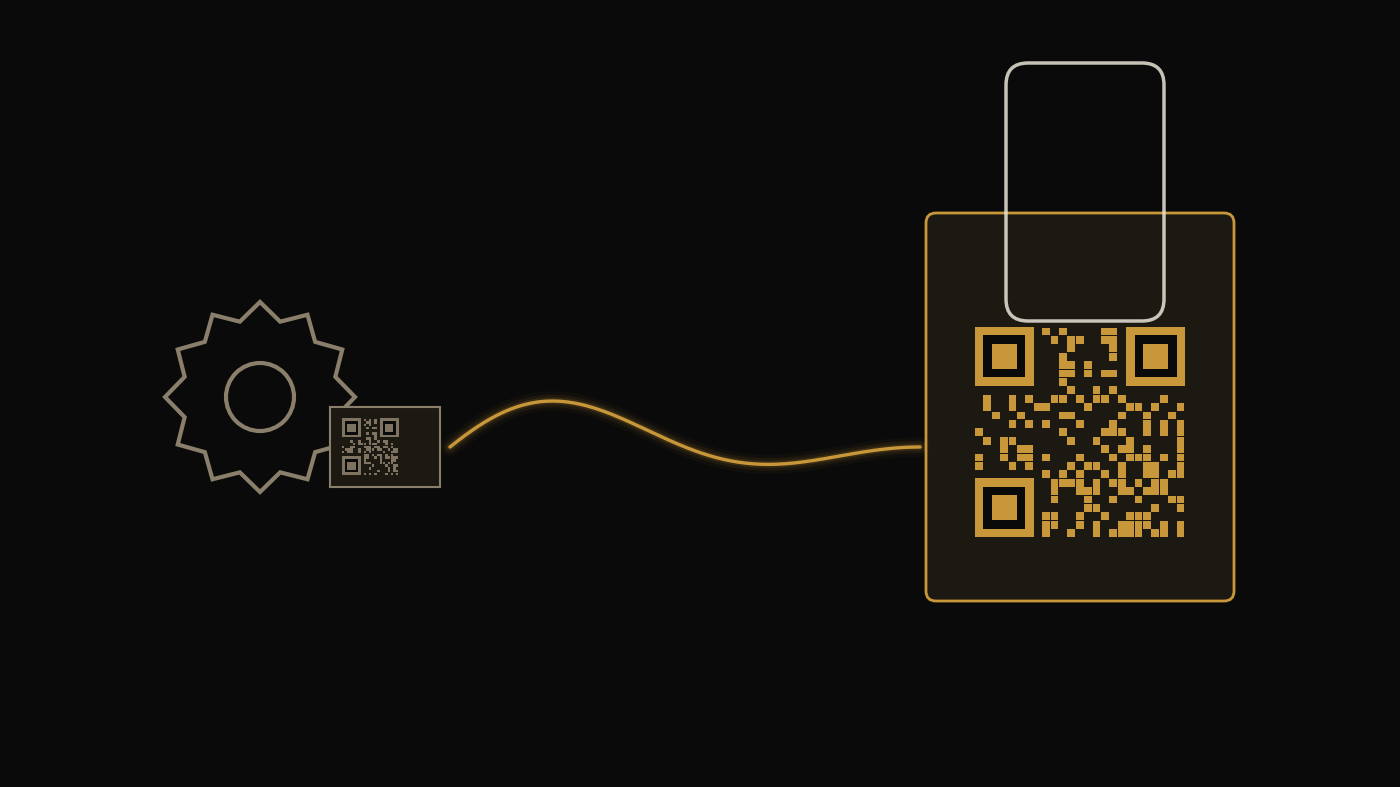
A car-parts engineer in Japan designed a square that could survive oil, dirt and torn labels. His company held the patents but chose not to enforce them against ordinary users. Three decades on, India is paying for its tea with it.
In the early 1990s, at Denso in Japan’s Aichi prefecture, an engineer named Masahiro Hara spent his lunch breaks over a Go board. Go is played with black and white stones on a grid of nineteen lines by nineteen. A stone placed a little off its intersection still belongs to that intersection, and players read its position without hesitation.
Hara’s day job was barcodes. Denso, a parts maker in the Toyota Group, had been printing them on the kanban cards that travelled with parts through Toyota’s just-in-time system. By the early 1990s the paperwork had outgrown the barcode.
Plants had to read around ten separate barcodes, each scanned one at a time, and workers had begun to complain.
Hara later recalled the problem in one plain sentence: reading the barcode had become more of a job than making the product.
His way out was a grid. A pattern of black and white squares could carry far more information than a row of lines. While his early designs struggled with blotched ink, the Go board offered a clue. A pattern read the way a player reads stones, by position rather than perfection, could survive smudges and small misplacements.
His code was released in 1994. It was meant for car parts. Three decades later, in October 2026, India’s Unified Payments Interface processed 25.47 billion transactions in a single month, about 822 million a day. Many of them began with someone pointing a phone at one of Hara’s squares, printed on a sticker beside a vegetable cart or a tea stall.
Between those two historical moments sits a decision most users have never heard of. Denso patented the code in Japan, the United States and Europe, and decided it would not enforce those patents against ordinary users.
A factory label became the front door of one of the world’s largest real-time payment systems. The journey begins with an engineer who wanted his code read from any angle, and a company that let anyone print it.
It begins on the factory floor.
A Code That Could Survive the Factory
Denso’s ties to the barcode go back decades. Hara told the story himself in 2019, in the Japanese research journal Synthesiology. About forty years before he wrote, Denso had proposed combining barcodes with Toyota’s kanban cards, the specification sheets that travel with parts through the just-in-time system. As volumes grew, barcodes replaced manual data entry and cut the errors that came with it.
Japan’s economic bubble burst at the start of the 1990s, and manufacturing changed shape. Plants moved from mass production to what Hara called “multiple product low volume” manufacturing.
Each part now needed more information, customers wanted to track individual components, and Japanese industry wanted labels that could carry kanji and kana characters as well as numbers. A one-dimensional barcode holds about twenty characters. Factories were printing rows of them and scanning each in turn.
Hara expected barcodes to reach a technical wall. In 1992, by his own account working as a team of two, he began designing a two-dimensional replacement. Others joined later; the European Patent Office’s 2014 award citation names five engineers.
They had no budget for hardware, so they started with the only thing that cost nothing to develop: the code itself. Hara persuaded his superiors that a reader could wait until customers had seen working code before asking for one.
Together, the pair made a series of choices that still define every QR code printed today. They chose a matrix of squares rather than stacked barcodes, accepting a harder reading problem in exchange for density.
They chose squares over circles because cheap, low-resolution printers could produce them reliably. And they built in Reed-Solomon error correction, the same family of mathematics used on compact discs.
Even at its highest error-correction setting, a code could still be read with up to 30 percent of its surface soiled or damaged. On a factory floor of oil, grease and torn labels, that margin mattered more than anything else.
Finding the code at all was the hardest problem. A scanner looking at a crowded label needs to know instantly where the code begins and which way it is turned. Hara’s answer was the three large squares that sit in the corners of every QR code, the finder patterns.
Each is built from black and white bands in a fixed ratio of 1:1:3:1:1. To choose that ratio, the team surveyed printed letters and figures, looking for the pattern least likely to appear anywhere else. They settled on the one with an extremely low chance of occurring by accident. Hara has also credited a second image: a tall building, seen from a window, standing out from everything around it.
By the team’s measurements, a code could be read in about 30 milliseconds. A single symbol could hold thousands of digits, where a barcode held about twenty characters.
Denso called it the Quick Response code, and released it in 1994.
A code that anyone could read still needed someone to decide who was allowed to print it.
The Patent Nobody Paid For
Denso filed patents on the QR code and was granted them in the United States in 1998, Japan in 1999 and Europe in 2000. According to the history Denso submitted for the code’s recognition as an IEEE Milestone, the company decided in 1996 not to use those patent rights against people who simply wanted to use the code.
To many readers, that sounds like giving the invention away. Hara’s 2019 paper describes something more deliberate. Denso split the technology into an open part and a closed part.
The code’s specifications were published and its patents left unenforced, so other companies could print QR codes and build products around them without paying or asking. The reading devices, and the image-recognition methods inside them, stayed closed, protected as trade secrets rather than patents. Denso would make its money selling readers into a market it had helped others create.
Denso did not abandon the patents. Hara wrote that owning the patents showed the code infringed no one else’s, which gave users a secure footing, and gave Denso a way to stop copies and corrupted versions.
The company’s policy was to warn violators first and enforce only if they refused to stop. By the time he wrote his paper, it had issued exactly one warning. A registered trademark did similar work, preventing weaker two-dimensional codes from calling themselves QR codes.
Japan’s Patent Office later presented the arrangement as an important reason the code spread. Because Denso made the specification open and the patent freely available, everyone could use QR codes without worry. Industries that traded globally, in automotive, electronics and distribution, then pushed for an international standard.
The code was standardised by AIM International in 1997, by Japan as JIS X 0510 in 1999 and by the International Organization for Standardization as ISO/IEC 18004 in 2000, six years after its birth.
A standard settled what a QR code was. It did not settle what anyone outside a factory would do with one.
For its first eight years, the answer was very little. QR codes labelled parts and tracked shipments, mostly unseen by the public. Hara’s team kept extending the design for industry: Micro QR in 1998 for tiny components, and support for Chinese, Taiwanese and Korean characters in 2001.
Hara’s paper includes an admission that seems stranger every year. When the code was being developed, the team did not assume that smartphones would ever be able to read it.
The Camera in Every Pocket
In 2002, Japanese mobile phones began to read QR codes, and the code left the factory. Newspapers, magazines and posters in Japan began printing squares that took readers to websites.
Openness brought a new problem: anyone could now read a company’s codes, including codes on its invoices. In 2007 Denso Wave answered with SQRC, a code with an open layer for any reader and an encrypted layer for authorised ones. Outside Japan, consumer use stayed patchy for years.
Smartphones changed that after 2010, and the change came fastest in China. In China, Alipay, Alibaba’s payment platform, received a payment licence from the People’s Bank of China in May 2011 and introduced its own QR code payments the same year.
Shops could accept money by scanning a code on a customer’s phone, or customers could scan a code printed at the counter. Tencent launched WeChat Pay in August 2013
A printed square needed no card terminal, no electricity and no monthly rental. For a street vendor it cost the price of a sheet of paper. By 2016, according to CGAP, a financial-inclusion research group hosted by the World Bank, transactions worth more than $1.65 trillion used the codes. Much of China’s retail economy moved from cash to phones without ever settling on plastic cards.
China’s system had a limit, though. Alipay and WeChat Pay each used their own codes and their own wallets, and a shop that wanted both had to display both. The square was open. The networks behind it were not.
India took a different route.
A Square on Every Counter
India’s payment plumbing was built for a different scale. In 2008, the Reserve Bank of India and the country’s banks set up the National Payments Corporation of India, registered as a not-for-profit company, to run shared retail payment systems. Through the early 2010s it added systems for instant bank transfers and for a domestic card network, RuPay.
On April 11, 2016, in Mumbai, Reserve Bank Governor Raghuram Rajan launched NPCI’s newest system, the Unified Payments Interface, alongside Nandan Nilekani, the former head of India’s Aadhaar identity authority, who was advising NPCI.
Twenty-nine banks agreed to join. Only those whose pilots reached 1,000 customers and 5,000 transactions with high success rates were allowed to go live. On August 25, 2016, UPI opened to the public with 21 banks.
UPI’s design made a choice that echoed Denso’s. It was built as a shared layer rather than a product. Any bank could join, and any app approved to connect to it could send money to any account on it, using a simple address in place of account numbers.
Payments from one app to a shop signed up with another worked the same way. A QR code, in this design, is simply a printed version of the account address that any UPI app can read.
For its first months, few people noticed. Across the whole of November 2016, UPI carried only about 300,000 transactions, even though that month brought the biggest push towards digital payments India had seen.
That November, the government changed the setting around it. On the evening of November 8, Prime Minister Narendra Modi announced that ₹500 and ₹1,000 notes, about 86 percent of the currency in circulation by value, would cease to be legal tender.
Cash became scarce for weeks. Mobile wallets such as Paytm surged first. The government released its own UPI app, BHIM, in December.
On February 20, 2017, the Reserve Bank’s deputy governor R. Gandhi launched BharatQR, developed by NPCI with Mastercard and Visa, with American Express also on board.
It was described at its launch as the world’s first interoperable QR acceptance system: a merchant would display one code instead of a different one for each network. Later that year, NPCI required UPI apps to read both UPI QR codes and BharatQR codes. The square in the shop was no longer tied to any one wallet.
A second decision about cost followed. From January 1, 2020, under rules announced by Finance Minister Nirmala Sitharaman, merchants stopped paying a merchant discount rate on UPI and RuPay transactions.
That is the fee normally deducted from card and digital payments. The Payments Council of India warned that this would make the business unviable for payment companies. For a tea seller, it meant a sticker that cost nothing to print and nothing to use.
NPCI’s monthly reports record what followed. By October 2026, UPI was processing 25.47 billion transactions a month, worth ₹31.53 lakh crore. A single average day now carries around 2,800 times as many transactions as the whole of November 2016.
That same month, NPCI deferred plans to introduce merchant fees on some UPI transactions until after Diwali. The Square itself remained free to print, as it had been since 1996. Who should pay for the payment behind it was being asked again.
The Thread
Read from end to end, the QR code’s journey turns on three decisions made by people who never met.
First came an engineering decision.
Hara and his colleagues designed a code for the worst conditions they could imagine: a greasy label half-hidden on a moving part. Thirty percent damage tolerance and a finder pattern chosen by surveying printed paper were built for car factories. They turned out to be what a crumpled sticker on a roadside stall needed.
Second came a decision about ownership.
Denso held its patents and chose not to enforce them, publishing the specification while keeping its readers closed. In 1996, it was a business strategy for an industrial product. It meant that when phone cameras arrived, nobody had to ask permission to print a QR code.
Third came a decision about networks.
China’s wallets showed a printed square that could replace a card terminal, but each wallet kept its own codes. India’s UPI and BharatQR made the code interoperable, and the zero-fee rule of 2020 made it free for merchants. The square became a shared infrastructure.
None of the three was made with the others in mind. Hara did not expect phones to read his code. Denso’s patent decision was about factories. India’s payment architects were solving for bank accounts, not for a Japanese labelling standard. Each decision left something open, and the next one built on what had been left open.
Engineer at Denso Wave
Masahiro Hara stayed with the code. Denso’s automatic identification business passed to a group company, Denso Wave, and Hara moved there in 2012. By 2023 he was its chief engineer. The European Patent Office named his team finalists for its European Inventor Award in 2014, and the IEEE has since recognised the QR code as a Milestone in engineering history.
When Hosei University, his alma mater, asked him in 2023 why the code had spread so far, he did not talk about Reed-Solomon codes or finder patterns.
He said it was because the code was licence-free. No technology is worth much, he added, if few people use it: “it is meaningless unless many people use it.”
He said he was happy that so many people do. In India alone, UPI carried more than 800 million payments a day in October 2026. Many of them begin with a phone held over a square on a counter, built three decades ago to be read from any angle, by anyone.
Sources
Papers
- Development and popularization of QR code: Code development pursuing reading performance and market forming by open strategy. Synthesiology English Edition, 12(1), 19–28
- Press release: NPCI presents Unified Payments Interface (UPI) system, April 11, 2016
- Press release: NPCI’s Unified Payments Interface (UPI) set to go live, August 25, 2016
- News release: BharatQR launched, February 20, 2017; R. Gandhi, Payment systems: next orbit
- Circular: Integration of Bharat QR with UPI credentials, August 2017
- UPI transactions hit 25.47 billion in October, November 1, 2026
Official records
News
- How a Board Game and Skyscrapers Inspired the Development of the QR Code
- ‘I’m pleased it is being used for people’s safety’: QR code inventor relishes its role in tackling Covid, December 12, 2020
- How Alipay is killing cash in China
- 2016: The year cashless payments trended upwards, December 27, 2016
- No MDR charge on payment via RuPay debit card, UPI, UPI QR code from Jan 1, December 31, 2019; BloombergQuint, Payments Council of India warning
- UPI’s record-breaking October puts merchant monetization back in focus, November 2026